This is not a post about politics, though it flowed from last night's Presidential Debate.
It struck me that John McCain regularly mentioned how he had been to various trouble spots around the globe. How he had gone directly to opinion makers. How he had been present at the place things were happening.
I don't think Senator McCain knows anything about Lean, nor did he cite Lean as a strategy for competitiveness. Yet he appealed for credibility by stating he had physically been where important issues were taking place. In Lean parlance, this is going to gemba.
Intrinsically, people ascribe credibility to those who are at the point of action. Our modern idiom "been there, done that" illustrates this further.
So, if a politician knows this intrinsically, why is it so hard for many mangers to physically show up at the place value is added?
Perhaps this is a time to learn from, rather than criticize, those running for office.
Click here to subscribe to Learning about Lean by email.
Saturday, September 27, 2008

Sunday, August 17, 2008
There's Clutter, then there's Clutter
When I posted recently about clearing out clutter, I had a couple of queries deserving response.
One of my work associates read the post, slipped quietly into my office and asked, in a hushed tone, “Joe, who did you tick off now?” I got a good laugh; the post was not directed at anyone. I simply was fed up with my own propensity for junk to pile up on my desk. As most of my posts, I wrote this one to myself.
Then, Joanna Rothman posted a comment asking about those who stay organized with everything out. Is this clutter? She poses a great point.
Many jobs require horizontal surfaces to be covered with relevant material. In particular, architects, project managers and building planners often need to work with large sheets of paper. They do no good rolled up in a drawer.
As in many things Lean, identical issues can be value-added in one setting and pure waste in another. Recall our usual revulsion at conveyor lines; yet in the chocolate factory it can add value by letting the gooey mix solidify before going to the packaging line.
To Joanna, I’d suggest the difference is in the intent. To answer the question “Is this piece of paper out because I need it or because I’m procrastinating trashing it or filing it?” If the former, leave it out; if the latter, well, it’s just plain clutter.
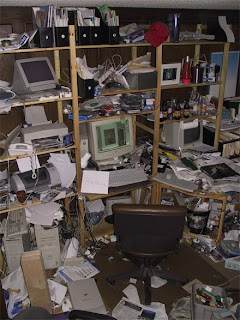
And each of us knows the difference.
So, keep getting rid of clutter. It just gets in the way.
One of my work associates read the post, slipped quietly into my office and asked, in a hushed tone, “Joe, who did you tick off now?” I got a good laugh; the post was not directed at anyone. I simply was fed up with my own propensity for junk to pile up on my desk. As most of my posts, I wrote this one to myself.
Then, Joanna Rothman posted a comment asking about those
 who stay organized with everything out. Is this clutter? She poses a great point.
Many jobs require horizontal surfaces to be covered with relevant material. In particular, architects, project managers and building planners often need to work with large sheets of paper. They do no good rolled up in a drawer.
As in many things Lean, identical issues can be value-added in one setting and pure waste in another. Recall our usual revulsion at conveyor lines; yet in the chocolate factory it can add value by letting the gooey mix solidify before going to the packaging line.
To Joanna, I’d suggest the difference is in the intent. To answer the question “Is this piece of paper out because I need it or because I’m procrastinating trashing it or filing it?” If the former, leave it out; if the latter, well, it’s just plain clutter.

And each of us knows the difference.
So, keep getting rid of clutter. It just gets in the way.
Saturday, August 09, 2008
Clutter
Why do we tolerate clutter? Is it a crutch? Is it an effort to hide the work we don't want to get done? We'll never know while it surrounds us.


All of them are clutter. Getting in the way. Distracting us.

The leader has enough distractions already. Why do we put more in our way?

Start with your desk. Then de-clutter your email inbox. Then, go make an apology to someone you’ve offended.
De-clutter. Daily.
It is essential.
Gotta get rid of the messes. The physical messes. The email messes. The relational messes. The structural messes.
All of them are clutter. Getting in the way. Distracting us.
The leader has enough distractions already. Why do we put more in our way?
Start with your desk. Then de-clutter your email inbox. Then, go make an apology to someone you’ve offended.
De-clutter. Daily.
It is essential.
Sunday, August 03, 2008
Passion and Tools, Part 2
I wrote recently about passion for a topic and the tools to excel in that topic. Here’s an example.
GTDtimes is a blog surrounding David Allen’s excellent book “Getting Things Done.” GTD is a wonderful system to help us deal with the crunch of “stuff” coming our way. In mid July one practitioner published Cool GTD Gear to Motivate Everyone in your Organization. A very good post, well conceived on tools for doing GTD.
In the comment section of the post, one reader said:
There you see it. A leader gave out tools and sought to motivate his team. Yet it didn’t really take.
The passion never took. And, left only with tools, the implementation was spotty.
Last week I heard a consultant present on the change process. He described two needs. The first was for alignment; getting all folks to understand the direction of the organization, in the right spots, equipped to achieve organizational results.
Yet, a second need remained which he termed atunement, the ability of people to buy in, at an emotional level, with these goals.
Alignment gives tools, yet atunement breeds passion. How does this happen in an organization? How do we, as Lean Leaders, build this passion? I’m learning this myself and welcome your input.
Be passionate and live it.
Click here to subscribe to Learning about Lean by email.
GTDtimes is a blog surrounding David Allen’s excellent book “Getting Things Done.” GTD is a wonderful system to help us deal with the crunch of “stuff” coming our way. In mid July one practitioner published Cool GTD Gear to Motivate Everyone in your Organization. A very good post, well conceived on tools for doing GTD.
In the comment section of the post, one reader said:
I was enthusiastic to the point of trying to mandate GTD among my team of 20 about two years ago. I only had spotty success and found myself doing what you have just described here…REMINDING people to follow the program. I have found that this road is a tough one. A different road I chose was to have everyone work on projects together in a group collaboration system. At least for those projects, we were getting things done and communicating about it. if they were not working on a project for me, I learned to let them do what worked for them.
There you see it. A leader gave out tools and sought to motivate his team. Yet it didn’t really take.
The passion never took. And, left only with tools, the implementation was spotty.
Last week I heard a consultant present on the change process. He described two needs. The first was for alignment; getting all folks to understand the direction of the organization, in the right spots, equipped to achieve organizational results.
Yet, a second need remained which he termed atunement, the ability of people to buy in, at an emotional level, with these goals.
Alignment gives tools, yet atunement breeds passion. How does this happen in an organization? How do we, as Lean Leaders, build this passion? I’m learning this myself and welcome your input.
Be passionate and live it.
Click here to subscribe to Learning about Lean by email.
Sunday, July 27, 2008
I want to build a house; What hammer should I buy?
My favorite marketing writer, Seth Godin wrote this brief bit of wisdom last week. I quote here the essence:
This hit me at several levels.
How often have I failed in explaining Lean because I focus on kanban cards or kaizen events rather on a passion for operational excellence?
How often have I failed by talking about seven wastes rather than the enjoyment of every work day for all workers?
Do I provide an example of a passionate operational leader or a bureaucratic box-checker-offer?
Lean offers tools which the passionate individual and company can use. The passion needs to be for the result, though, not the tools; even we need to know the tools every bit as well as the finish carpenter knows her miter saw and laser level.
This hits me deeply…I hope it does you as well. Let your passion show.
Click here to subscribe to Learning about Lean by email.
I want to write a novel. What word processor do you recommend?
Yesterday on the radio, Jimmy Wales was talking about the Wikipedia movement. A caller who identified himself as a strategist at Amnesty International asked: We're going to build a website to promote freedom and democracy and human rights. What software should we use?
Really.
If you want to do something worth doing, you'll need two things: passion and architecture. The tools will take care of themselves. (Knowledge of tools matters, of course, but it pales in comparison to the other two.)
Sure, picking the wrong tools will really cripple your launch. Picking the wrong software (or the wrong hammer) is a hassle. But nothing great gets built just because you have the right tools.
This hit me at several levels.
How often have I failed in explaining Lean because I focus on kanban cards or kaizen events rather on a passion for operational excellence?
How often have I failed by talking about seven wastes rather than the enjoyment of every work day for all workers?
Do I provide an example of a passionate operational leader or a bureaucratic box-checker-offer?
Lean offers tools which the passionate individual and company can use. The passion needs to be for the result, though, not the tools; even we need to know the tools every bit as well as the finish carpenter knows her miter saw and laser level.
This hits me deeply…I hope it does you as well. Let your passion show.
Click here to subscribe to Learning about Lean by email.
Friday, July 18, 2008
A Tale of Two Meetings
In attending back-to-back meetings last week, I saw much.
Meeting one involved three of us trying to solve a logistics problem. The organizer set it up at the spot of the problem and involved just the people who had a stake in it’s solution and had the tools to fix it. We stood up for about 35 minutes, touching the offending product problem. The organizer had compelling and clearly presented data, plus she offered some solutions. The meeting had both facts and emotional punch. We settled the issue quickly and the solution was soon implemented.
I then attended a more traditional meeting. We gathered around a conference table in comfortable chairs. We looked at Power Point slides of black text on a white background. One person attending brought some product samples, which added a visual clue to the problem we were trying to solve. Yet, it didn’t have the energy or the punch of the first meeting.
Now, the Lean folks among us will say, in Pavlovian fashion, “Yep, that’ll show ya, gotta have the meeting in gemba, get to the workplace.” True. But why?
My favorite marketing writer Seth Godin wrote recently about how to organize the room for a meeting. Well worth the read, he makes the point we all walk into a meeting room, look around and quickly pick up clues about how we should behave. Often, this is at cross purposes with what we need to get done. So, he says, change up the clues! Make it look different…you’ll get a different response.
Which is why meeting in gemba so often works. It changes the clues. What do I do when I don’t have a chair? What do I do when there is noise in the room? What do I do when I’m faced with a wall full of product rather than a nicely paneled wall?
Try it.
Click here to subscribe to Learning about Lean by email.
Meeting one involved three of us trying to solve a logistics problem. The organizer set it up at the spot of the problem and involved just the people who had a stake in it’s solution and had the tools to fix it. We stood up for about 35 minutes, touching the offending product problem. The organizer had compelling and clearly presented data, plus she offered some solutions. The meeting had both facts and emotional punch. We settled the issue quickly and the solution was soon implemented.
I then attended a more traditional meeting. We gathered around a conference table in comfortable chairs. We looked at Power Point slides of black text on a white background. One person attending brought some product samples, which added a visual clue to the problem we were trying to solve. Yet, it didn’t have the energy or the punch of the first meeting.
Now, the Lean folks among us will say, in Pavlovian fashion, “Yep, that’ll show ya, gotta have the meeting in gemba, get to the workplace.” True. But why?
My favorite marketing writer Seth Godin wrote recently about how to organize the room for a meeting. Well worth the read, he makes the point we all walk into a meeting room, look around and quickly pick up clues about how we should behave. Often, this is at cross purposes with what we need to get done. So, he says, change up the clues! Make it look different…you’ll get a different response.
Which is why meeting in gemba so often works. It changes the clues. What do I do when I don’t have a chair? What do I do when there is noise in the room? What do I do when I’m faced with a wall full of product rather than a nicely paneled wall?
Try it.
Click here to subscribe to Learning about Lean by email.
Sunday, June 22, 2008
Getting to Email Zero
Following my recent post on Minimizing Work-in-Process for Knowledge Workers, several folks wrote and asked me to write more on getting their email inbox to zero. I put together an outline for such a post.
When I discovered I didn’t need to write anything further.
In Yes, You Can Stay on Top of Email, Michael Hyatt describes all you need know to empty your email inbox. Daily. Yes, daily. Hyatt writes the blog From Where I Sit. As the CEO of a major publishing company, he’s a busy guy who also thinks a lot about process. Long time blogging buddy Frank Patrick clued me to Hyatt’s blog a while back and I’ve come to appreciate his input.
Go read Hyatt’s post. Then, start applying it. Today. Not tomorow. Now. I highly commend his outline. And add two more points.
First, find a way to turn off email. In July 2007, unannounced, I started only sending and receiving emails once an hour at work. I found the way in Outlook to automatically send and receive email once an hour. I write them anytime I need to...but they only go out once and hour. Amazingly, not one single person I work with has asked me about this. For a full year. Now maybe they think I'm a jerk and haven't told me. I suspect, though, it simply hasn't been an issue. In fact, the only way any of them will know I do this is if they read this post! Yes, you can do the same. It really eliminates a LOT of distractions.
Second, find a way to separate personal and business emails. Most of us with regular jobs have a mandated email program for work. So use it. I strongly suggest getting a web-based email for your personal use. I’ve used several and Gmail is my vastly preferred choice.
Don’t let email run your life…get on top of it. Now.
Click here to subscribe to Learning about Lean by email.
When I discovered I didn’t need to write anything further.
In Yes, You Can Stay on Top of Email, Michael Hyatt describes all you need know to empty your email inbox. Daily. Yes, daily. Hyatt writes the blog From Where I Sit. As the CEO of a major publishing company, he’s a busy guy who also thinks a lot about process. Long time blogging buddy Frank Patrick clued me to Hyatt’s blog a while back and I’ve come to appreciate his input.
Go read Hyatt’s post. Then, start applying it. Today. Not tomorow. Now. I highly commend his outline. And add two more points.
First, find a way to turn off email. In July 2007, unannounced, I started only sending and receiving emails once an hour at work. I found the way in Outlook to automatically send and receive email once an hour. I write them anytime I need to...but they only go out once and hour. Amazingly, not one single person I work with has asked me about this. For a full year. Now maybe they think I'm a jerk and haven't told me. I suspect, though, it simply hasn't been an issue. In fact, the only way any of them will know I do this is if they read this post! Yes, you can do the same. It really eliminates a LOT of distractions.
Second, find a way to separate personal and business emails. Most of us with regular jobs have a mandated email program for work. So use it. I strongly suggest getting a web-based email for your personal use. I’ve used several and Gmail is my vastly preferred choice.
Don’t let email run your life…get on top of it. Now.
Click here to subscribe to Learning about Lean by email.
Thursday, May 22, 2008
Minimizing Work-in-Process for Knowledge Workers
We all know the drill; work-in-process is a problem in manufacturing. It ties up cash, limits flexibility, masks problems, decreases customer satisfaction. We’ve seen the “lower the water level; expose the rocks; fix the problems” illustration.
It’s no different in non-manufacturing setting. Making it personal, it’s no different for me, either. I’ve been bugged the last few years by this concept and, finally, have seen some progress over the last few months. Let me illustrate, in hopes you might find something useful.
My first step was to isolate just what constitutes WIP for me in my managerial role. I concluded it is all in two places:
Some folks might add Voice Mail to this list, making three piles. For me, VM is not a big deal so I simplified it to two.
And these two are crucial. Virtually everything I do which does not involve face-to-face meetings flows through these two portals. And the degree to which I do or do not deal, promptly, with both flows does all the things WIP does in the manufacturing setting. It ties up cash (slow decisions), limits flexibility (“we’re waiting on Joe”), masks problems (I don’t respond), decreases customer satisfaction (“he's avoiding me”).
The breakthrough that hit me a few months ago is classic lean. I have always tried to minimize and optimize these two queues. Not good enough. I realized I had to take them to zero. Empty. Zip. No email in the in box. No paper in the in box.
Zero is easy to measure and observe. Impossible to fudge. And, I have found, amazingly liberating.
The further breakthrough was pragmatic. In a dynamic business environment, I can't keep the boxes empty. So, my quest is to get to email zero and/or in box zero once in every business day.
Here’s my current metric. A simple blue 3x5 index card. With an “E” for days I get to email zero and an “I” for in box zero.
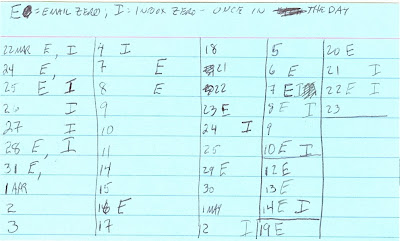
You can see I don’t get it done every day. I've had some bad streaks. The metric, though, is huge. It sits there on my desk as a brutal reminder I have not flushed out email for 3 days, that I’m avoiding something in my in box.
It’s not perfect. But it is way better than my other efforts. And, as goofy as it sounds, it's fun to get to zero and record the "E" or "I".
How to get to email zero or in box zero? That’s another discussion…if you’re interested, please let me know and I’ll write on either.
But, until I settled on a) the location of WIP b) the zero standard for WIP and c) the simple measurement of WIP, I was not making progress at all.
Hope you can find something here you can use.
It’s no different in non-manufacturing setting. Making it personal, it’s no different for me, either. I’ve been bugged the last few years by this concept and, finally, have seen some progress over the last few months. Let me illustrate, in hopes you might find something useful.
My first step was to isolate just what constitutes WIP for me in my managerial role. I concluded it is all in two places:
- My physical in-box. This is all the physical junk that lands in my office. Papers, forms, mail, memos.
- My email in-box. All the electronic junk that comes my way.
Some folks might add Voice Mail to this list, making three piles. For me, VM is not a big deal so I simplified it to two.
And these two are crucial. Virtually everything I do which does not involve face-to-face meetings flows through these two portals. And the degree to which I do or do not deal, promptly, with both flows does all the things WIP does in the manufacturing setting. It ties up cash (slow decisions), limits flexibility (“we’re waiting on Joe”), masks problems (I don’t respond), decreases customer satisfaction (“he's avoiding me”).
The breakthrough that hit me a few months ago is classic lean. I have always tried to minimize and optimize these two queues. Not good enough. I realized I had to take them to zero. Empty. Zip. No email in the in box. No paper in the in box.
Zero is easy to measure and observe. Impossible to fudge. And, I have found, amazingly liberating.
The further breakthrough was pragmatic. In a dynamic business environment, I can't keep the boxes empty. So, my quest is to get to email zero and/or in box zero once in every business day.
Here’s my current metric. A simple blue 3x5 index card. With an “E” for days I get to email zero and an “I” for in box zero.
You can see I don’t get it done every day. I've had some bad streaks. The metric, though, is huge. It sits there on my desk as a brutal reminder I have not flushed out email for 3 days, that I’m avoiding something in my in box.
It’s not perfect. But it is way better than my other efforts. And, as goofy as it sounds, it's fun to get to zero and record the "E" or "I".
How to get to email zero or in box zero? That’s another discussion…if you’re interested, please let me know and I’ll write on either.
But, until I settled on a) the location of WIP b) the zero standard for WIP and c) the simple measurement of WIP, I was not making progress at all.
Hope you can find something here you can use.
Sunday, May 11, 2008
Why do visuals help?
Several recent observations converged for me. 
Why do drawings make decision making clearer? People a lot smarter than me have looked hard at this. I simply see that it works.
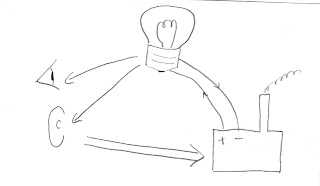
Somehow, the drawing, however simple or clunky, engages a different part of the brain. Flowing through both the eyes and the ears, the idea finds a different path to the processing parts of the brain. In this way, new understandings of tough problems emerge. The original idea then burns more brightly, more clearly, with more focus.
Go doodle somewhere. It usually helps.

- A colleague drew a Value Stream Map for a new process we were developing. Two major barriers became clear. In 45 minutes, we had a plan to overcome them, problems that had bugged us for six months.
- We had a struggle over a particular system of nomenclature; the group of six were stuck. One member then walked to the whiteboard, drew a simple diagram of his understanding. Then another person modified this diagram with her perspective. Soon, all six people had added to the drawing. And a solution became obvious.

- A vendor was preoccupied with the splendor of his proposal and talked and talked. One of our engineers then asked him to draw how his system worked. Reluctantly, he began putting boxes and arrows on the board. And the conversation turned to solutions. Egos faded.
- A friend of many years invited me for lunch to discuss an important decision he faced in his career. A visual person to begin with, he had put an elegantly simple line drawing capturing the history, context, and trajectory of his options. Making the drawing, coupled with the active discussion, made choices clearer.

Why do drawings make decision making clearer? People a lot smarter than me have looked hard at this. I simply see that it works.

Somehow, the drawing, however simple or clunky, engages a different part of the brain. Flowing through both the eyes and the ears, the idea finds a different path to the processing parts of the brain. In this way, new understandings of tough problems emerge. The original idea then burns more brightly, more clearly, with more focus.
Go doodle somewhere. It usually helps.
Sunday, April 13, 2008
Toyota Tour, opus 5
Last Friday, eight engineers from our group of companies and I had the chance to tour Toyota’s North American Fork Truck manufacturing facility, Toyota Industrial Equipment Mfg (TIEM). I continue to be astounded and grateful for the openness, transparency and astounding skills of Toyota.
This was my fifth walk through this plant. My first trip was in August 2000 and I was there most recently in October 2005. I wanted to use this visit to grasp more of the “how” of the Toyota Production System.
My colleagues were making their first visit to a Toyota facility. Not surprisingly, they were blown away by the cleanliness, systemization and flow of the place. The innumerable small tools, carts, jigs, jib cranes, rollers were astounding, as was the ergonomics, the attention to detail, the visual communication and sheer energy of the place.
And this plant let us get up close and personal to the energy. Unlike Toyota’s large car plants, this facility employs only about 650 people, making about 130 fork trucks per day on four final assembly lines. Thus, we could easily walk the entire plant in a little over an hour, with time to stop and observe items of interest. There was no catwalk tour or trolley train…we were on our feet, very much in gemba.
Two events while there capture my observations.
When we arrived and were greeted by our host, she led us to a table holding our name tags. She then requested we make sure our names were spelled correctly. One of my colleagues with a complex last name chuckled softly to herself observing two transposed letters; it was not a problem to her. Our host was listening carefully, however, to the response to her question. Immediately, she asked what the correction was and, over my colleague’s mild objection, took the name tag to correct it. Her assistant disappeared into an office, caught up with our group about 3 minutes later and personally delivered the now-correct name tag.
What happened ? It was a line stop. There was an error and, at Toyota, you simply do not allow a known error to proceed. Ever. In this case the error detection method was inspection by a qualified person; each one of us checked our own name. More specifically, this was a pull on a yellow cord (signaling an error but not stopping the process) rather than a pull on the red cord (signaling a complete stoppage of the process). Our tour continued to the next stop yet they corrected the error. My colleague was wowed; I commented to her it was impossible for them to NOT fix the mistake. This is consistent with foundational principles of the TPS; rapid error detection and correction (jidoka) and respect for people.
Late in our walk around, our host invited us to look at an area of the plant displaying extensive manufacturing data. As our tour group of 9 looked, I noticed the area rapidly filling up with Toyota staffers. Our host introduced me to one of them, the plant's Director of Quality. He quickly explained: “This is our 2:35 meeting. We gather daily to discuss quality problems in the past 24 hours.” Conveniently, it was 2:35pm…I stuck around to hear what went on.
Attending were the Plant Manger, the senior managers of functional areas and a number of Team Leaders. With no fanfare and all attendees simply standing up in the metrics area, the meeting promptly started with a discussion of an error discovered late in the day Thursday. The Team Leader of the area briefly described the problem (a missing latch). He then introduced an associate from the line who gave detaila on what went wrong and how he missed installing the latch. The Team Leader then resumed the brief presentation, describing the countermeasure their group had already installed to prevent this from happening again. The whole discussion of this single problem took perhaps three minutes. The senior managers of the plant heard directly from an hourly employee what happened and how his group planned to fix it.
Describing this in text loses the impact of the moment, though. I observed the body language, the tone and the mood of the meeting. It was these factors which astounded me. The group was attentive and welcoming to the associate and Team Leader. Their walk matched their talk of wanting to know about problems. There was no hint of blame or punishment. The obvious expectation was the work group itself could fix problems and their fix would eliminate errors. Further, was the expectation the group could act promptly. I could feel it…and it was mind-boggling to see the culture this plant had built through thousands of repetitions of such discussions.
At 2:45, the meeting ended and the group which had assembled so promptly dispersed just as quickly…again, the context of speed and action rang true.
Two brief vignettes illustrate what must happen hundreds of times each day at this small plant in a quiet corner of Indiana. It was a moving and challenging day. My nature is to mull this for some time…yet I’m also challenged to make something happen soon.
Click here to subscribe to Learning about Lean by email.
This was my fifth walk through this plant. My first trip was in August 2000 and I was there most recently in October 2005. I wanted to use this visit to grasp more of the “how” of the Toyota Production System.
My colleagues were making their first visit to a Toyota facility. Not surprisingly, they were blown away by the cleanliness, systemization and flow of the place. The innumerable small tools, carts, jigs, jib cranes, rollers were astounding, as was the ergonomics, the attention to detail, the visual communication and sheer energy of the place.
And this plant let us get up close and personal to the energy. Unlike Toyota’s large car plants, this facility employs only about 650 people, making about 130 fork trucks per day on four final assembly lines. Thus, we could easily walk the entire plant in a little over an hour, with time to stop and observe items of interest. There was no catwalk tour or trolley train…we were on our feet, very much in gemba.
Two events while there capture my observations.
When we arrived and were greeted by our host, she led us to a table holding our name tags. She then requested we make sure our names were spelled correctly. One of my colleagues with a complex last name chuckled softly to herself observing two transposed letters; it was not a problem to her. Our host was listening carefully, however, to the response to her question. Immediately, she asked what the correction was and, over my colleague’s mild objection, took the name tag to correct it. Her assistant disappeared into an office, caught up with our group about 3 minutes later and personally delivered the now-correct name tag.
What happened ? It was a line stop. There was an error and, at Toyota, you simply do not allow a known error to proceed. Ever. In this case the error detection method was inspection by a qualified person; each one of us checked our own name. More specifically, this was a pull on a yellow cord (signaling an error but not stopping the process) rather than a pull on the red cord (signaling a complete stoppage of the process). Our tour continued to the next stop yet they corrected the error. My colleague was wowed; I commented to her it was impossible for them to NOT fix the mistake. This is consistent with foundational principles of the TPS; rapid error detection and correction (jidoka) and respect for people.
Late in our walk around, our host invited us to look at an area of the plant displaying extensive manufacturing data. As our tour group of 9 looked, I noticed the area rapidly filling up with Toyota staffers. Our host introduced me to one of them, the plant's Director of Quality. He quickly explained: “This is our 2:35 meeting. We gather daily to discuss quality problems in the past 24 hours.” Conveniently, it was 2:35pm…I stuck around to hear what went on.
Attending were the Plant Manger, the senior managers of functional areas and a number of Team Leaders. With no fanfare and all attendees simply standing up in the metrics area, the meeting promptly started with a discussion of an error discovered late in the day Thursday. The Team Leader of the area briefly described the problem (a missing latch). He then introduced an associate from the line who gave detaila on what went wrong and how he missed installing the latch. The Team Leader then resumed the brief presentation, describing the countermeasure their group had already installed to prevent this from happening again. The whole discussion of this single problem took perhaps three minutes. The senior managers of the plant heard directly from an hourly employee what happened and how his group planned to fix it.
Describing this in text loses the impact of the moment, though. I observed the body language, the tone and the mood of the meeting. It was these factors which astounded me. The group was attentive and welcoming to the associate and Team Leader. Their walk matched their talk of wanting to know about problems. There was no hint of blame or punishment. The obvious expectation was the work group itself could fix problems and their fix would eliminate errors. Further, was the expectation the group could act promptly. I could feel it…and it was mind-boggling to see the culture this plant had built through thousands of repetitions of such discussions.
At 2:45, the meeting ended and the group which had assembled so promptly dispersed just as quickly…again, the context of speed and action rang true.
Two brief vignettes illustrate what must happen hundreds of times each day at this small plant in a quiet corner of Indiana. It was a moving and challenging day. My nature is to mull this for some time…yet I’m also challenged to make something happen soon.
Click here to subscribe to Learning about Lean by email.
Subscribe to:
Posts (Atom)