Tuesday, April 12, 2011

Gumbo from Gemba

I was recently watching the popular Food Network show Diners, Drive-ins and Dives with the irrepressible Guy Fieri as host.  If you haven't seen it, the show's shtick for the 30 minutes is to find three out-of-the way restaurants, each with local color and some unique foods.  He then takes cameras into the kitchen and, with rapid conversation and aggressive tape editing, describes how a killer inside-out burger or Mama's Meatloaf comes to be for faithful patrons.  

Why is the show popular, though??  I wondered and observed.  

They shoot the show in the kitchen.  For a restaurant, this is truly gemba, the place where value is created.  The kitchens are often cramped, dingy, greasy; hardly from an ad for an appliance maker.  The chefs are not actors but cooks, people who both know and love what they do.  

The fact that this is so appealing tells me a lot.  People want to know about how value is created.  They are interested in what goes on.  Dare I say, they would like to know about the process which leads to the result?  The kitchen clatter on the show is as much about technique as it is about ingredients.  

The cooks are truly the experts...they know more than anyone about the product and the process.  Guy goes right to them and gets them to talk and explain.  

Do we, as lean leaders, spend enough time in gemba to get greasy, to smell the burned mistakes, to feel the heat, to sense the time pressure, to realize why the flour has to be stored where it is?  

And, if we do, are we not better able to explain why we do what we do, in a way that makes our gemba as attractive as the hot-dog joint at a resort?  

Mind you, some gembas taste better than others.  But we can each work hard to give ours it's time to be heard.  

Keep on learning.


.


Sunday, April 03, 2011

System Optimization, Chain Saw Style

Not that we really rush into these things, but my wife and I have talked for a couple years now about tearing out three huge, gnarly, 40+ year-old bushes in the corner of our back yard. And, once they were gone, what would we do with the 300 sq feet of space we'd expose? Gretchen settled on a pleasing, artistic plan during the winter and we awaited a break in the weather to do the deed. Last Saturday's weather looked favorable, so we rented a chain saw and went to work.
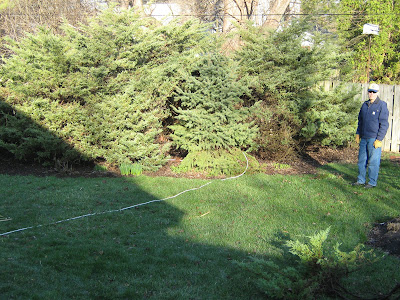
The Starting Condition

Our respective tasks became quickly obvious, due to skill and temperament. I got the chain saw and Gretchen wanted to make sure the pile of cuttings was stacked well in the street (she's on a city agency for tree health and knows the guys who pick up such cuttings...she wants to stay on their good side, you see). I waded into the bush, started removing one branch after another as Gretchen began dragging them, 2 or 3 at a time, the 40 meters or so to the street.

And it hit me; this was a process, just like any other process. So, could we improve it? And what could we learn as we improved it?

The task quickly got a lot more interesting (to me, at least) than merely a spring landscaping job. Several relevant facts became readily apparent:
  • It took me far less time to cut a branch than it did for my wife to drag it to the street.
  • We had only two people to do this job
  • We wanted to get the whole job done before the start of the NCAA Semifinals, around 6pm local time.
  • Safety was a factor when using a chain saw and lifting heavy, bulky branches
  • The end result had to be visually pleasing
  • The end result had to build, rather than stress, our relationship.
So, we did some job balancing on the fly. I added to my job; when I cut a branch, I then drug it out of the bushes to a "staging area" nearer the front, reducing her walk by about 10 meters. I made secondary cuts in branches, where necessary, to reduce the size of each branch (safety) and to make it easier to stack on the street (staying pals with the street department). In so doing, I slowed the pace of cutting (improving safety and allowing saw to avoid overheating). This reduced some of Gretchen's job. She had less walking and less work to identify and pull out a branch to drag.

Our visual system to implement this work balance was using a simple, limited "work in process" inventory...I'd leave one or two branches in the staging area. When Gretchen came and pulled them out, I'd cut a couple more to place as WIP. This simple choice had two unexpected benefits. First, it kept our back yard cleaner, as all the straggling branches were in one place, not spread all over. Second, it allowed her to watch the slowly unfolding deconstruction of the bushes. This served to better decide what to eventually leave which would be pleasant to observe out of our back window.

A further learning point from our formerly ugly bush; In doing this work balance, we intentionally "under used" our rented chain saw. It could have had a much higher duty cycle...I could have had all the cutting done in a little over an hour, rather than the three hours we used. Instead, we focused on system speed (getting the branches safely to the curb) rather than point speed (cutting as many branches with the saw as rapidly as possible).


The End Result

We were pleased with how this worked out. As we hacked away, Gretchen observed an unusual, circular set of large branches in one bush, which she felt we could shape into something attractive. We also kept, with a smile, a spruce which our middle son, now 30, brought home as a 4" sapling in third-grade. Somehow, that spruce has made it through three sons and over 20 Indiana winters. It has earned a little more room to prosper.

We cleaned up and sat down, together, to have lunch a little after 1pm, chuckling at how well we hit all the objectives of the morning. We had extra time to do some other tasks before cheering Butler on to it's win over VCU. One remaining task? I suspect a plate of chocolate-chip cookies might still be in order for the street cleaning guys.
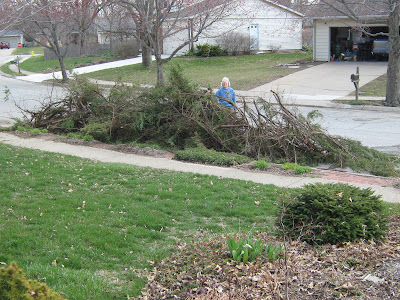
Pile o' cuttings

Processes are everywhere. And we can learn from any process, if we choose to see. Good luck on your spring cleaning tasks and learn much from them!

Click here to subscribe to Learning about Lean by email.

Sunday, March 20, 2011

Are they metrics or are they numbers?

In recent discussions about metrics, I've been wondering about the apparent fascination with metrics.

Each metric is a number.  Each is a measure of some activity, some process.  

But what do we do with the metric/number once we have it?

All too often, I see discussions devolving into how the number is derived or where it comes from or what the right unit is.  And I truly wonder if we like the metric or if we like the number. 

A metric is simply an indicator, a gauge of some activity we deem important.  A number, on the other hand, is an arithmetic construct which can be averaged, summed, square-rooted and put into a spreadsheet. 

To fix a metric requires going to see a process to understand what really makes it work.  To fix a number requires analysis, averaging, summing, square-rooting, spreadsheeting. 

Processes are messy.  They usually involve people.  They don't always respond the way we expect.  

Numbers are clean.  They are usually abstract.  They average and sum and square root the way we expect, so long as our spreadsheet formulae are correct. 

Processes deliver product.  Numbers don't.

Is the fascination with numbers merely another example of taking the path of least resistance? 

.


Wednesday, March 16, 2011

Lean Behaviors: Trust

We don't talk about trust all that much in the Lean community. 
 
Perhaps we should a little more.
 
Why?  Because we ask people to do some rather counter-intuitive things as we try to set up a Lean system.  Like follow standard work even to the point of running out of raw materials.  Why do we do this?  So we can more quickly discover where other pinch points are.  We want to expose waste.  We, who think a lot about Lean and the systems thereof and want to find waste.
 
But, wait a minute, buster, says our associate.  I've seen this movie before and I know how it ends.  If I work hard and expose a shortage somewhere else, either I get in trouble or my pal who works over there gets in trouble and, either way, it isn't good.  No, I've learned to survive by making a work-around and then keeping the whole system "looking good". 
 
And she is right.  It makes no sense, based on her experience, to work hard to expose waste.
 
Unless.
 
Unless you and I, leaders in our organizations, act differently as well.  Unless we demonstrate exposing waste gets rewarded, not punished.  Unless we walk the talk ourselves. 
 
Unless we say thank you. 
 
Unless we demonstrate respect for her opinion. 
 
That's trust.  And, without it, all the waste we so nobly hope to find remains hidden.
 
Keep on learning.
 
 
.


Sunday, March 13, 2011

Book Review: Gemba Walks by Jim Womack

Jim Womack has done yet another wonderful service for the Lean Community with his most recent book "Gemba Walks".  I've already greatly benefited from it on a first read.  Why?


Repetition.  Creative, clear, shapeful repetition. 


Jim brings a remarkable clarity to the task of explaining, encouraging and directing lean implementations.  In this book, he pulls together his written record of walks through a multitude of companies over the past ten years.   He published these records in monthly email newsletters during this time, most of which I remembered reading.  This text shuffles the observations into themes.  Womack adds depth, context and linkage with brief paragraphs before each one.   


And the core theme comes through.  Repeatedly. 


Look.  Find the problem.  Work hard to find root cause.  Fix it.  Repeat.  Experiment relentlessly.  


With story after story, Jim explains how this simple pattern works when applied relentlessly.  And how getting bored with repeating this pattern is a plan for mediocrity or worse. 


Jim's relatively recent observation of outdated management systems undermining genuine excellence comes out in two new essays in the collection. 


For a person new to Lean, "Gemba Walks" will quickly teach much.  For those of us in the trenches, there is both encouragement and more than a few good kicks in the pants.  For senior execs trying to understand Lean, this is way better than more Power Point slides.


In many ways, this book may well also serve as an excellent reference.  Jim organized the chapters to align with common sets of problems we see.  One simple read of a chapter will take less than 10 minutes and I found each would trigger 2-5 quality ideas to test.  Soon.  


Simple steps, done repeatedly and consistently, work.  Womack explains this clearly.  Well worth the read.  

Wednesday, January 12, 2011

A low-tech personal management system

It's a new year and I've noted a plethora of ads and blogs in the last week touting ways to "turn over a new leaf" by using some new technology tool on a phone or laptop.  It's a noble cause and useful endeavor. 
 
When it comes to organizing one's business and personal life, I've not found any better system than the one described in Getting Things Done by David Allen.  Importantly, GTD is not software but a system of principles.  I first read Allen soon after his book came out in early 2003 and went through several iterations of implementation.  I finally put a system together which worked.
 
The system is decidedly low tech; it consists of a small, organized stack of colored 3x5 inch index cards held by a bulldog clip.  No batteries to recharge, no Internet connection, no usage fees.  I wrote up the entire system in this post on the GTD Connect blog in April, 2008.  I re-read it last week in response to all the urgings to try new apps.  I chuckled that, 2.5 years later, the simple system I wrote up then still works, daily, for me. 
 
So, if you are trying to find a way to organize yourself, I commend GTD to you.  Feel free to use my  implementation to trigger your own thinking to take more effective action with less waste.
 
Keep learning.


.


Sunday, December 12, 2010

Lean Behaviors: Mock Up, Part 2

Taking my own advice (and that of a colleague), we did a life-size mock up Friday of a new, pull-based scheduling system.  We did it with the folks who will have to use it.


What did we learn?

·         How much physical space it would take

·         Our initial thought on label clarity was inadequate

·         The concept will likely work

·         Three other assumptions were slightly off target

·         Batching is built into our DNA

·         Flow is tough to learn


How did we learn it?

·         We watched the space it would take

·         We watched clumsiness in working with kanban cards

·         We listened to language

·         We watched moods change from comprehension to confusion to frustration to insightful satisfaction


What will we do?

·         We handed out three assignments to get at by Monday at 9am

·         We scheduled a repeat of the mock up later on Monday morning


In short, we did a pile of learning and a pile of teaching in a mere 90 minutes at virtually no cost just by doing a mock up and simulating three days' production cycle. 


No computer screens in sight. 


Seven people, sitting, walking, scowling, asking, listening, talking, moving, adjusting, clarifying. 


90 minutes. And I truly don't think it would have happened as well had we not done the mock up.  


Well worth it.


.


Wednesday, December 08, 2010

Lean Behaviors: Mock Up

I was reminded twice today of the criticality of a simple, life-size mock up of a proposed change.  In our virtual, digital world (witness this blog :-) ) we mostly sit, staring at a computer screen.  Subtly, that becomes reality to us.

It becomes more of a shock and of supreme use to make up a model of a process.  

  • Use a refrigerator box as a "machine".  
  • Stand at a kitchen counter to model an assembly.  
  • Use empty milk jugs to simulate fluid flow.  
  • Write with washable markers on a wall to see how a pipe should run.  
  • Use playing cards to simulate kanban pick up and delivery.  
  • Put tape on the floor to show where you would walk between process steps.

Mock it up.  Now.  It's amazing what it will trigger for your learning.  

And then keep learning.


.


Wednesday, December 01, 2010

Lean Behaviors: Trusting Signals

Fundamental to any Lean implementation is Just in Time delivery. JIT is driven by pull signals, flowing opposite the direction of product, requesting an upstream.  Thus, everything depends on the human reaction to that signal, be it a physical kanban card, an electronic signal, a specified container, or the arrival of a tugger.
 
And humans want to know; Is the signal reliable?  Can I depend on it?  Does it tell me, every time, precisely what to do?  Does it make my life better?
 
An answer of "no" or "maybe" or "well, it should" is enough to derail the pull system.
 
Humans need to trust the signal.
 
The signals need to be trustworthy. 
 
When a pull system isn't working, it's usually one of these two. 
 
Keep on learning.
 
 
.


Monday, November 22, 2010

Lean Behaviors: Hard work, in reality

One of the appeals of Lean is its framework to describe, from a high altitude, how a process or collection of processes should operate.  It appeals to readers. 
 
To sell books on Lean, one needs only to tell the stories of how those processes should operate.  It appeals to authors. 
 
Understanding the books and the stories makes one literate on Lean, able to use the lingo, able to fly over a situation and offer advice.  It appelas to senior executives. 
 
Implementation, however, is the truly hard work of Lean.  By definition, implementation is at a low altitude, encompassing detail.  It's hard to write interesting books about the boring, long grind of implementation. 
 
And the true leader accepts this, buckles down, and implements anyway. 
 
The leader does the hard work.
 
The one who does the hard work is the true leader. 


.